Emergency Roof Repair in Elizabeth from $150. Made safe tonight, priced properly when it is dry. Two jobs, two figures. Free inspection and a written quote.
When you ring, say what is underneath the wet area and whether this started during rain or during a thaw. The second answer is the one that matters most in winter: if it is a thaw leak, the water will stop when the melt does, and a tarpaulin is not what you need.
An emergency call is about containment, not repair. The aim is a cover that holds until the roof can be seen in daylight on a dry day, and it is quoted as its own item -- because anybody putting a firm price on a permanent repair in the dark in a storm is pricing what they cannot see.


The repair itself is priced like any other, $350 to $1,800 for most jobs. Containment -- making it safe tonight -- is a separate item, and out-of-hours attendance is quoted before we set off rather than added afterwards. We do not publish a percentage because no New Jersey figure for one exists that we would stand behind. Locally, two things move a repair quote more than the repair does. Whether the leak has been patched before, because undoing somebody else's sealant is real work. And whether the eaves have an ice barrier, because on most of this housing they do not, and that changes what a repair down there can honestly achieve.
Making it safe tonight and repairing it properly are separate pieces of work on separate visits. A firm price for the second one, given in the dark in the wet, is a price for something nobody has seen.
If the water started during a thaw rather than during rain, it is meltwater backing up behind ice and it will stop when the melt does. The useful work that night is containment inside and a diagnosis afterwards.
Daylight and wind, in that order. We will tell you honestly when nobody should be on a roof, because the alternative is a cover that blows off and a second emergency.
Two failures dominate repair work across this city. Chimney flashing, because a masonry stack moves independently of the roof it passes through and pre-war housing has one on nearly every property. And the eaves in winter, on the many roofs that were never built with an ice barrier under the first three feet.
Elizabeth's housing is old enough that most roofs here predate the ice-barrier detail entirely, which is why the same leak comes back every February on some streets.
Tell us what is underneath the wet area when you ring. A bedroom, a stairwell, a shop unit or a tenanted flat each change what we bring and in what order we work. And tell us what the weather is doing where you are: a temporary cover in a gale is a different piece of work from one in still rain, and sometimes the honest answer is that nobody should be on that roof tonight.
Including us. On repair work the checks are different from the ones people apply to a replacement, and cheaper to make.
New Jersey registers home improvement contractors rather than licensing roofers, and the number belongs on every advert and contract. The register is public. The wording is a tell as well: the code says not to call it a license, so a New Jersey roofer advertising their roofing 'license' has not read the rules closely.
'Repair roof' is not a scope. 'Rebuild step flashing to the chimney, replace two vent boots, re-lap the valley' is -- and it can be checked when it is finished, which is the point.
Ask before, not after. A repair aimed at a named cause can be stood behind; a patch aimed at a stain cannot, and a contractor who is vague about the cause will be vague about this too.
Most repair calls in this city are second-time calls: a leak somebody has already paid to fix, back again.
Most roofs in this city predate the ice-barrier detail entirely, which is why the same eaves leak returns every February on some streets.
On pre-war housing the answer is usually the chimney.
Most low slope in this city is a rear extension or a porch, and it was built with marginal fall because the run is short.
The eaves are where winter does its work on this housing, because most of these roofs predate the ice-barrier detail.
This is the commonest leak in the city, and the reason is simply how much pre-war housing there is.
Flat roofs behind parapets. Access is the first problem.
Low ground, open water. Which way is the water going?
Post-war and often overlaid, so the eaves are buried.
Steep pitch. Specific details fail, not the field.
Rear additions and garages, and their junctions.
Built as a set, so the street is a reliable guide.
The widest age spread. Age decides where to look.
The questions that decide this job, answered up front.
Usually, where there is daylight left and the wind allows. What we will not do is pretend a permanent repair can be specified in the dark in the wet. We contain it, photograph what we find, and price the real work when the roof is dry.
If water is near a light fitting or a socket, switch that circuit off at the board first. Then clear what you can from underneath and get a container under the drip. A ceiling holding water should be relieved deliberately at its lowest point over a bucket rather than left to come down. And note whether it is raining -- if it is not, say so, because that changes everything.
Most New Jersey roof repairs run $350 to $1,800, with minor work from $150 to $600. A leak is usually $400 to $1,400 and a small isolated one $400 to $900. Flashing is $300 to $900, or $300 to $1,200 around a chimney, vent or skylight. New Jersey runs above the national average on labor, which is why online calculators read low.
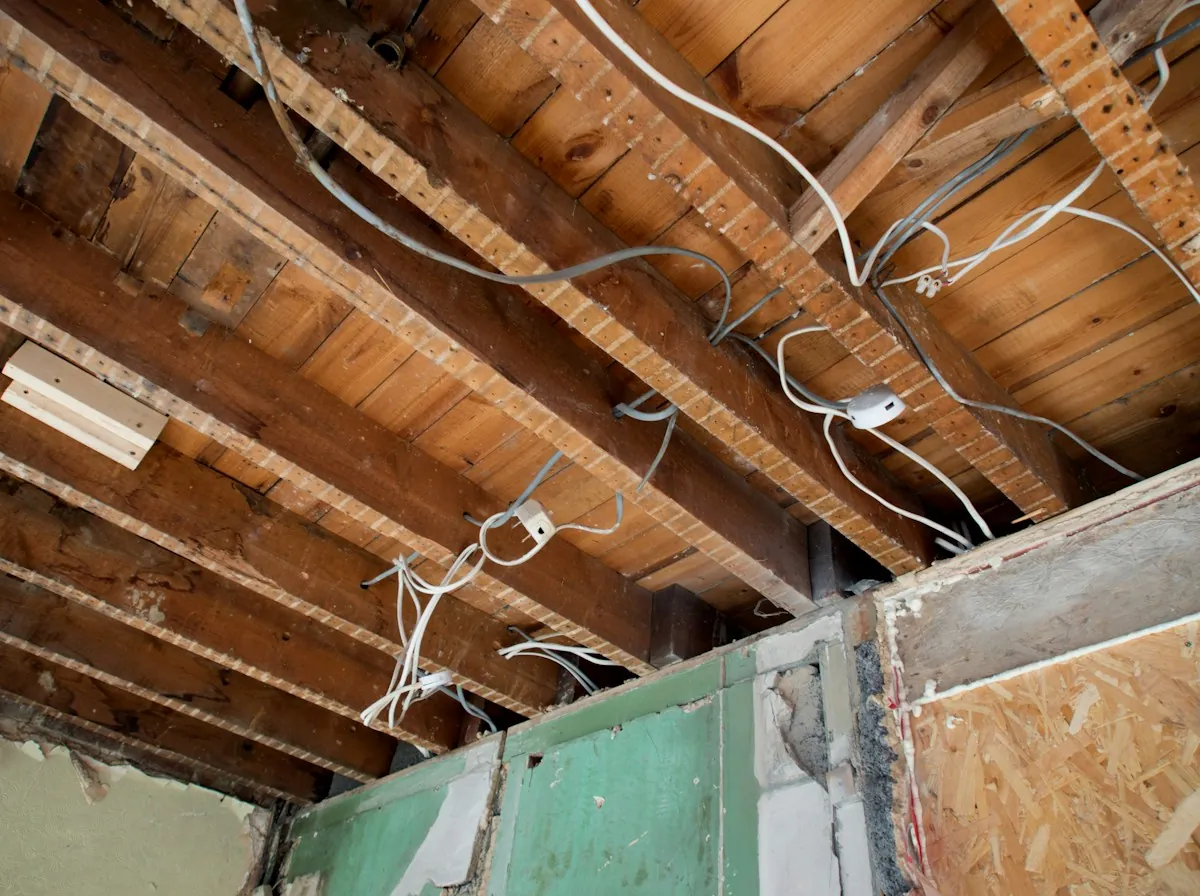
Almost certainly because the repair went where the ceiling was wet rather than where the water entered. Water gets in at a junction, runs along a rafter and drops at the first low point, which on a shallow pitch can be several feet away. That is why the roof space gets inspected here before anything is quoted -- the underside of the deck shows the direction of travel.
Usually not. New Jersey treats repair or replacement of an existing roof covering on a DETACHED one- or two-family dwelling as ordinary maintenance under N.J.A.C. 5:23-2.7 -- no permit, no notice, no inspection. Attached houses, buildings with three or more units and anything structural are the exceptions, and we tell you which you are at the survey.
The roof space walked as well as the roof, before any price. The cause named in writing, not just the work.